
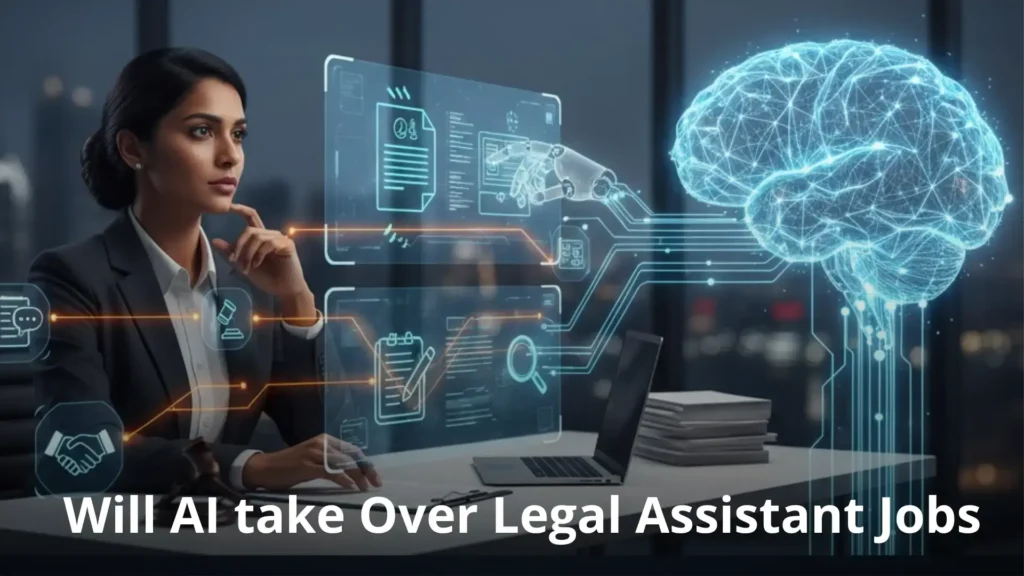

You’ve probably seen it everywhere: “AI is coming for legal jobs.”
Headlines, podcasts, and even LinkedIn debates make it sound like robots are about to replace every paralegal and legal assistant overnight.
If you work in the legal field, this may feel somewhat disturbing. You likely are asking yourself:
Will AI really take over legal assistant jobs?
Will law firms continue to need human expertise when software can draft contracts, summarize cases, and search databases faster than you can blink?
One thing you can be certain of, though. AI is transforming the legal industry, not eliminating it.
According to Thomson Reuters (2024), over 65% of law firms now use some form of AI for research or document review. But experts agree: AI cannot replace human judgment, empathy, and ethical reasoning.
Let’s consider what that means and what the future holds for paralegals and legal assistants in truth.
What Are the Roles of Paralegals and Legal Assistants?
The titles of paralegals and legal assistants may sound similar; however, in a law office, their roles are very different.
Paralegals
Paralegals are specialists in substantive legal work, researching laws, drafting contracts and pleadings, preparing witnesses for trials, and helping to build the strongest case possible by doing critical thinking behind the scenes.
Legal Assistants
Legal assistants are more involved in administrative support work such as scheduling, organizing client files, managing billings, and coordinating communications.
The requirements of law office life in order to achieve maximum efficiency, and, with deadlines being strict, documents must be filed properly.
Heyeve.ai is a good place to dive into the future of AI and justice, the intersection of virtual reality and innovative legal technology.
How AI Is Currently Impacting Legal Professions?
Today, AI tools are already an established part of the workload of everyday legal practitioners.
Programs like Casetext CoCounsel, Harvey AI, and Lexis+ AI can:
- Review contracts for mistakes and omissions
- Search case law in seconds
- Compose first drafts of letters or agreements
- Prepare summaries of large volumes of discovery data
In a survey, sixty percent of firms using AI reported that they had managed to save more than twenty hours per week on routine tasks.
That’s a huge gain, of course, but it doesn’t mean people are being replaced. Time-stealing tasks have been given back to them and directed toward strategy, client service, and managing complex analysis.
AI can be very productive, but it cannot interpret subtle differences in meaning, apply ethical motivation, or make personal connections as a human can.
When AI Gets It Wrong: Limitations and Risks
AI can accomplish a great deal, but it can also be very wrong.
If you have heard about stories with chatbots to give legal citations that did not exist, or lawyers who were fined for trusting AI-generated cases, then you must know the risks of automated operations unaided by human intelligence.
Even the most advanced legal AI systems, such as ChatGPT, Harvey, or Casetext CoCounsel, still face the following major problems:
Lack of Context and Judgment
The AI can sum up a case, but does not really understand what it means.
Legal work requires interpretation, winning, and analyzing facts, previous constitutions of law, with a long history of experience in your pocket. Something only human reasoning can take care of.
Hallucinations and Errors
At times, AI will ‘hallucinate’ by generating false case names or wrong citations.
One time when this actually occurred, a lawyer submitted bogus cases precedent set by ChatGPT-and was eventually penalized by the court for it. It serves notice that AI is not always correct, even when it looks its status confident in itself.
Ethical and Confidentiality Concerns
Opening AI tools to personal clients can endanger client confidences as well as bar rules.
Many firms today are creating their own private and secure AI systems-but even they await human supervision.
Bias and Over-Confidence
AI learns from past data. If the data is biased in favor of a race or class, then its results will reflect that bias too.
It might inadvertently reinforce stereotypes or disregard in a case, depending on the results that are likely to be unrepresentative for most people in similar circumstances.
So while AI has tremendous power, it is also fallible. Legal professionals must still verify, interpret, and bring their own personal judgment into each task that an AI helps with.
The eDiscovery Reality Check
AI really gives the most impressive results when it comes to eDiscovery essentials (it is also good at faltering here, too), that is, examining digital evidence in lawsuits.
Never mind millions of emails, messages, documents, or phone calls. AI can scan through them all in a fraction of the time humans may.
But there’s a caution about speed.
It’s just that fast does not mean smarter.
AI tools can recognize keywords and patterns in data, but they are not able to decide whether a document is legally relevant, privileged, or sensitive. They have to wait for the humans with particular paralegal skills nowadays to provide context and ethical judgment that’s needed in this situation. They still had to rely on humans to oversee final quality control and take advantage of opportunity checks and resources.
AI may do the heavy lifting in data review, but humans decide what actually matters in court.
That’s why, even in the most automated law firms, AI support does not replace legal professionals.
Related: https://heyeve.ai/blogs/will-ai-replace-paralegals/
Will AI Replace Paralegals and Legal Assistants?
This question has been asked countless times. Few are really able to give a clear answer, as search engines tend to favor the “popular” interpretations:
Will paralegals and legal assistants be replaced by AI?
The short answer is no.
But the real answer is much more nuanced: The future of paralegals and legal assistants is not extinction, but development. In other words, you could say whether there’s any hope for them at all.
Let’s break down for the readers’ information:
Fact: AI can augment the work of paralegals
AI is very useful for doing repetitive tasks that follow a fixed set of rules.
It can search through thousands of documents, check for potential risks in contracts, and sum up a deposition transcript of six hours in just minutes.
That means paralegals no longer have to waste their time on masses of dull data work. In a few words, they now spend most of their efforts on case strategy and quality research, with some left over for supporting their clients directly: This is where an intelligent human touch is actually needed.
Think of AI as a power tool, not a substitute. Although it multiplies your skills, it is still you who controls every step.
Fact: Human expertise cannot be replaced
Law is built from human experience: perceiving the tone of voice, intent, and feeling behind an utterance.
AI can’t tell you why former legal decisions were decided, or obtain from clients sensitive information in an interview situation that could upset them. Nor is there such a thing for it to navigate as how a judge might react.
Clients don’t trust programs; they trust people.
That is why the importance of empathy, moral principles, and communication will always be deeply rooted in legal support work
Fiction: Paralegals will become obsolete
Paralegals are not redundant; in fact, their role is changing.
According to the 2024 Legal Technology Report conducted by the American Bar Association, paralegal job loss was not recorded with firms that implemented AI; instead, they trained their staff to do higher-quality work: Compliance, project management, and AI-guided case review were all tasks of greater value.
Rather than being scared by AI advances, smart paralegals are starting to control these changes themselves.
Fiction: Job losses are guaranteed
Though news media everywhere mention layoffs, the numbers tell another story
The United States Bureau of Labor Statistics estimates that there will be steady growth in paralegal and legal assistant professions until 2032, around 4% growth per year, with tens of new jobs opening every year.
This new legal tech is creating jobs in different areas, but not less so, and particularly in places like AI governance, where there haven’t been any positions until now for people who work behind the scenes.
Future: Transformation, not replacement
AI Is Inventing How, Not Who
It turns more and more of the profession towards efficiency, collaboration, and insight.
With AI tools as part of a paralegal’s everyday work, learning how to spur them on effectively, critically review their output, and mix human reasoning with digital precision, it will become even more valuable in the future.
In brief:
AI won’t take over legal assistant jobs.
But legal professionals who neglect AI may find themselves laid off.
The future belongs to people who combine technical knowledge with human judgment, not one or the other.
Suggested Read: https://heyeve.ai/blogs/ai-in-legal-education/
How Law Firms Can Leverage AI
AI is enabling law firms to work smarter, not smaller.
Rather than making staff redundant, it automates everyday tasks so teams can concentrate on strategy and customers.
- Research & Drafting: Tools such as Casetext and Lexis AI. Not only do they draft up documents, but they are also able to speed through cases for you (both together).
- Contract Review: Seconds to spot missing clauses or bad terms.
- Client Intake: Chatbots collect basic info and arrange appointments around the clock.
- eDiscovery: AI makes it easy for data to be scanned and for relevant evidence to be quickly found.
- Admin Jobs: Billing, filing, and planning become automatic procedures, demanding a few hours from the payroll each week.
When used correctly, AI boosts accuracy and efficiency, client service, not job layoffs.
Tasks AI Cannot Handle for Law Firms
No matter how intelligent robots are, there are some things only human judgment can fill in for.
AI still struggles with:
- Understanding emotion, tone, or empathy
- Making ethical or moral decisions
- Negotiating creatively
- Understanding context and culture
- Keeping the confidential trust of clients
AI is a tool. It’s up to the human mind, with its reasoning and compassion, to prevail in the end.
Expert Opinions on the Future of the Paralegal Profession
The Conclusion by Legal Experts: AI will change, rather than eliminate, paralegals.
- Thomson Reuters (2025): Using AI in firms only leads to increased efficiency, not less manpower at all.
- Harvard Law Center: Paralegals will evolve into AI-assisted analysts.
- ABA: Calls for the industry to lift higher AI ethics and literacy training.
In short, paralegals who master AI tools and marry them with human insight are the future of legal support.
Upskilling for Paralegals and Legal Assistants in the Age of AI
The best way to adapt is to cooperate with AI, rather than make a fuss about it.
In today’s workplace, law offices are looking for paralegals and legal assistants with both a solid grounding in law and a facility with the latest technology.
This is how to get a head start in the new era.
Master Data Analysis & Legal Tech
Learn modern legal technology like Relativity, Casetext, and the latest in legal artificial intelligence from Harvey AI.
With the ability to understand data, automation, and prediction tools, you gain a large competitive advantage over everyone else.
Enhance Project Management
AI can make workflows faster, but people still lead them.
Your skill in classification, organization, process control, and improvement measures means that you are still irreplaceable in the eyes of an employer.
Strengthen Soft Skills
Empathy, communication, and critical thinking are still beyond the reach of automation.
These abilities also help establish trust, navigate complex issues with clients, and humanize law work.
Learn AI Limitations
Learn to distinguish between when AI helps in making and where human judgment is vital.
The professionals who understand this and have both strengths along defects will handle any possible errors found in AI’s functions to maintain a level of quality control that is even more demanding than before.
Invest in Continuous Learning
The legal field changes in the blink of an eye.
An online certificate, an artificial intelligence literacy class, or a professional development course could help retain your market advantage as others go downhill fast.
The future belongs to paralegals who assimilate sound writing skills as well as a spirit of understanding about technology.
Are you set to equip your legal team for the age of AI? Get in touch with us now to initiate the transformation of your firm’s operations, learning patterns, and results delivery.
Let’s Talk!
The Real Future: Transformation, Not Replacement
AI won’t swallow up legal jobs. It will change what they do. Just as email displaced telexes, AI is doing away with obsolete occupations rather than humans. Those who adapt will find new opportunities in compliance with legal technology and AI-supported research. AI isn’t going to replace paralegals. It’s merely the latest stage in their evolution.
Conclusion: A Reality Check on AI Predictions
Now then, will AI swallow up all the jobs of an enlightenment legal assistant?
No, but it is suggesting the future shape of many jobs. AI is automating shabby jobs by taking care of repetitive work. This lets people put their time towards work-based ethics, insightful thought, and building relationships.
The future of law is not AI versus humans. It is AI with humans where technology lifts the heavy load and professionals contribute what truly matters; judgment shapes human values.