
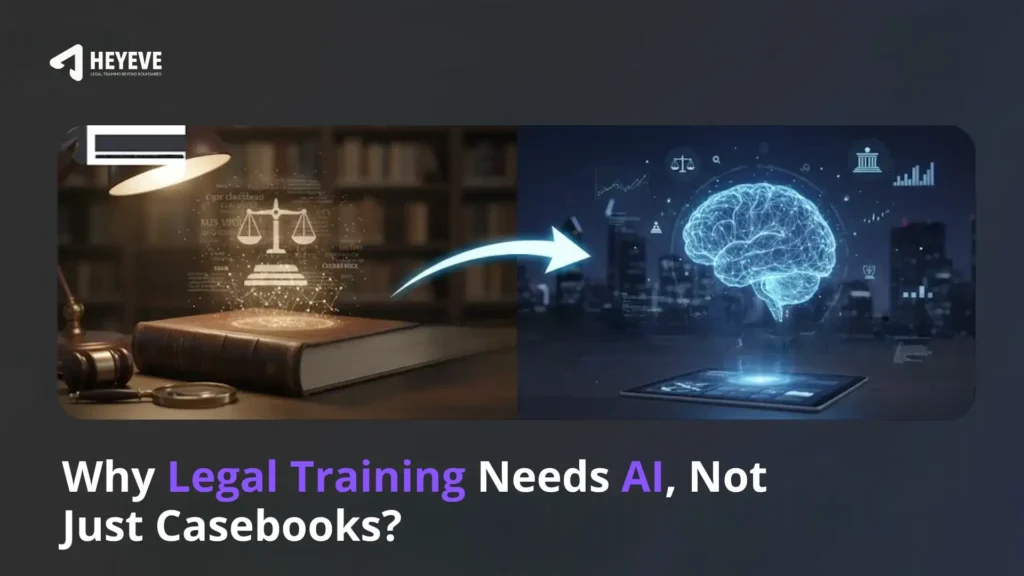

“Law is reason free from passion.”
This was said centuries ago by Aristotle.
But in reasoned decision-making of 2025, it is not just logic that counts; it is also shaped by data.
And that data is predicated on AI.
Every other large law firm uses artificial intelligence to evaluate a case, prepare documents, and even predict the outcomes. Still, too many university students are stuck in classrooms with dusty casebooks that were printed long before the first computer was ever constructed.
So, here lies the real question:
How long can we continue to train future lawyers to argue casebooks that are 200 years old, in a formula-driven world?
Ultimately, while the law in question is timeless, the approach and the means deployed to educate should not be.
If the courtroom is changing, then the classroom should change.
And that is where AI comes in, not to replace the casebook, but to change how we educate future lawyers in the age of technology.
The Problem with Traditional Legal Training
For decades, law schools have trained students using one teaching tool: the casebook. Those hefty volumes filled with precedents and judicial opinions shaped how generations of learned lawyers think. However, the world of law is no longer regulated by paper.
Most lawyers today utilize digital databases, e-discovery tools, predictive analytics, and AI-assisted drafting. Still, most classrooms prepare students for a world that existed long before the Internet.
The result? A growing gap between what is taught and the practiced reality.
In the 2024 Thomson Reuters Legal Tech Report, 68% of law firms responded that they struggle to find graduates who understand the basic tools of the tech-laden workflows. Students engrain ruling and memorize, only to lose the essential skill of task rationalization automation.
Traditional training also lays the assumption that every case is to be worked on and analyzed the same way, but today’s practice of law is complex and demands speed, precision, and the ability to interpret and manipulate data, skills disengaged case books cannot provide.
In short, the law isn’t outdated. The way we teach it is.
Related: https://heyeve.ai/blogs/why-law-firms-should-adopt-ai-chatbots-2025/
How AI Is Transforming Legal Education?
AI will not replace professors or rewrite textbooks; rather, it will improve the way students learn.
Think of it as a digital mentor, streamlining the study of law through interactivity, real-world applications, and data.
Students are no longer forced to scour hundreds of pages. In fact, they can:
- At Stanford’s CodeX Program, for instance, students study court technology and focus on the machine learning aspects.
- Developing tools that identify case outcome bias is a real-world task that students at Harvard’s Legal Innovation Lab undertake.
The fact is, law students learning with AI can analyze cases more quickly, develop greater ethical reasoning, and become more prepared for real-world situations.
Revolutionary legal education will no longer require students to read about the law; it will empower them to work with it.
That will be the legacy of the next generation of lawyers.
Case Study: Law Schools Leading the AI Shift
Artificial intelligence in legal education is not just a theory anymore; it is a reality.
Many leading law schools around the globe are embedding AI in their curricula and are providing students with the opportunity to use technology suited for real-world legal practice.
Harvard Law School: Legal Innovation Lab
At Harvard’s Legal Innovation Lab, students work at the meeting point of law, technology, and data by using AI systems to assess documents for judicial bias, automate document reviews, and run simulations to predict case outcomes. This teaches them how technology can identify gaps in and opportunities to improve the justice system.
Stanford Law School: CodeX Program
At Stanford’s CodeX (Center for Legal Informatics), students combine law with computer science and design thinking. Students discover how machine learning analyzes legal documents, organizes contracts, and streamlines access to justice. CodeX graduates are not just lawyers; they are digital law innovators.
University of Toronto: LegalTech Initiative
Canada’s University of Toronto has a more hands-on philosophy. For the LegalTech Initiative, students use AI-powered technology for predictive analytics, automated legal processes, and ethical legal automation, which will allow them to face future legal challenges with appropriate counterparts.
According to each of those projects:
AI doesn’t weaken legal education; it elevates it, turning theory into reality.
Heyeve empowers modern law schools to integrate VR-powered AI-driven learning and innovation.
Benefits of Integrating AI into Legal Training
So why should every law school actively embrace AI?
Because it makes legal learning quicker, smarter, and more relevant than ever before.
Improved Decision-Making
The availability of massive legal datasets through AI enables law students to spot trends and connections that the casebooks simply cannot. It teaches them data-driven reasoning, not memorization.
Accelerated Legal Research
The American Bar Association (2024) has reported that AI tools can reduce research time by as much as 60 %. Instead of having to spend hour after hour flipping through pages, now in minutes one can get done whole pages and do a deeper study too.
Real-World Readiness
Harvey AI, Casetext CoCounsel, and Lexis+ AI are already being used by law firms worldwide today. Graduates who have had an early exercise in these tools are surely capable in the contemporary legal environment.
Ethical Sensitivity
AI raises new questions about data privacy, bias, and responsibility. Law school students are trained to use technology responsibly, not only how AI functions, but also how it should be integrated into the law.
AI does not take the place of a living, thinking person. At best, it gives the human mind an edge. That is what true legal education in the modern age is all about.
Related: https://heyeve.ai/blogs/ai-in-lawyer-training/
AI Tools Every Law Student Should Learn
Quickly, here are AI-powered tools that are changing the way law students learn and engage in study:
| Tool | Function | Why It Matters |
| Lexis+ AI | AI-driven legal research assistant | Simplifies complex case research and highlights key rulings |
| Casetext CoCounsel | Automates document review and drafting | Cuts hours of repetitive legal work |
| Harvey AI | Built on GPT-based systems for law firms | Helps draft contracts, memos, and client communications |
| Premonition | Predictive analytics for case outcomes | Trains students in data-based litigation strategy |
| ROSS Intelligence | Natural language legal research tool | Improves analytical reasoning and search accuracy |
Thinking strategically is the key to mastering these tools; they are not things you have to teach yourself coding in.
Tomorrow’s top attorneys will be the ones with a strong grasp on using AI to think more deeply, more quickly, and more fairly.
Addressing Concerns: Will AI Replace Legal Professionals?
Of course, it is not actually true that AI will now want your law degree.
What it will do is make the qualification itself more effective.
The fact is that artificial intelligence can automate legal research, draft contracts, and analyze case data faster than any human ever could. But what it can’t do is think ethically, empathize with clients, or stand up for justice in a court of law.
World Economic Forum (WEF) 2025 predicts that AI will create over 97 new employment roles worldwide, many of them calling for a combination of human and AI. Law is one.
AI may substitute tasks, but not talent.
A machine can summarize a judgment, but it cannot feel the moral momentum of the judgment itself. It can process facts, but it is unable to help judge who did right or wrong.
In place of asking “Will AI replace lawyers”?
A better question to ask is: “Will the lawyers of tomorrow know how to use AI?”
Those who do will be the pioneer of their profession. Yet those who don’t may find that they start to lag.
Introducing the next wave of smart thinking into your legal training with Heyeve, consequently helping tomorrow’s lawyers get their start today.
Contact Us!
The Future of Legal Education: AI + Human Intelligence
Law has always evolved with society, from manuscripts to digital databases. Recently, the law has taken on the growing role of artificial intelligence. Future legal education may be less about memorizing cases than it is about understanding data patterns, analyzing algorithms, and integrating human judgment with digital insights.
Law schools that think ahead are already incorporating such hybrid models of learning, combining theory and AI simulations and working with data scientists to make smarter legal systems. They are also guaranteeing that every student and teacher maintains continuous AI literacy. The most successful 2030 graduates will not only master law; they will be able to collaborate with technology, showing through action that future leading lawyers are those who cooperate with AI rather than fight it.
Conclusion
AI doesn’t break with the past but instead continues its development. If casebooks lay the groundwork for law, artificial intelligence is pointing towards a future path. Tomorrow’s lawyers will stick out from their predecessors not by memorizing precedent but, rather, by being able to analyze data, adjust for technology, and offer expert judgment in new ways. In an age more influenced by algorithms, the real strength will still belong to the human mind, one that knows enough to play along with AI, not against it. The courtroom for everyone tomorrow will be one of hybrid intelligence; human, moral in construction, and way smarter than anything does today.