
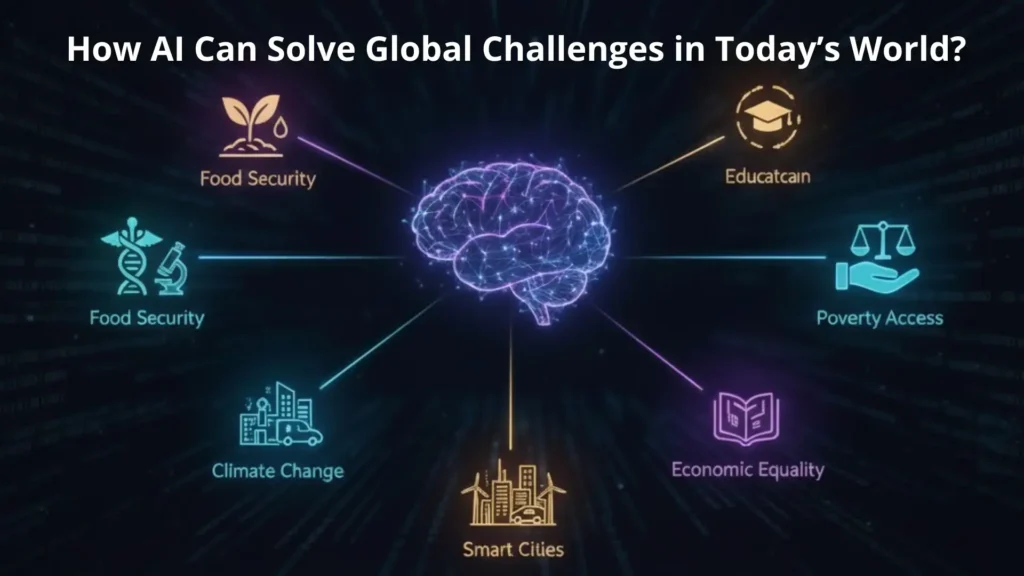

Did you ever ask yourself why the world is continuing to get smarter, but our biggest ills continue to appear unsolved? Poverty. Climate change. Disease. Hunger. These problems impact every one of us. And the fact is that traditional solutions are no longer sufficient.
But here’s the good news:
Artificial Intelligence (AI) is providing man a new weapon to address these global problems, faster, smarter, and on a scale with which we have never confronted them before.
According to McKinsey, AI can contribute at least 13 trillion to the global economy by 2030, and a significant part of that effect would be in solving real-world problems, not merely in making business more efficient.
And with this, we will deconstruct in the most simplistic manner imaginable, how AI can solve global challenges.
The Current Landscape of AI Adoption
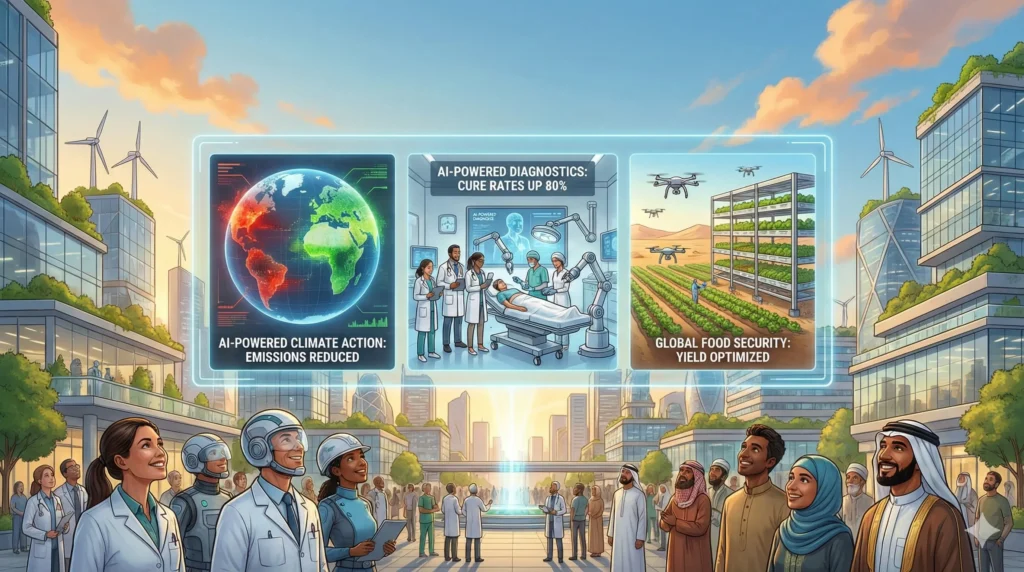
AI is no longer a future idea. It is already an integral part of life.
When we open our phones, we use them, when we search on Google, and even in cases when medical scans are read by doctors.
AI adoption is rising fast.
According to a report by McKinsey, more than half of the companies are currently applying AI in at least one of their business functions.
Governments are spending as well. AI tools are helping schools, hospitals, and even small businesses to work smarter.
What is the significance of this to solving global problems?
Because AI is growing more rapidly than any other technology.
With this speed, we have the ability to approach big problems such as climate change, poverty, and illness with a sense of new confidence and capability.
Related: https://heyeve.ai/blogs/ai-solutions-for-legal-marketing/
Global Challenges and the Need for Innovative Solutions
The problems that the world is undergoing cannot be addressed using traditional means.
Climate change is becoming a phenomenon.
The healthcare systems are congested.
Billions of people are still exposed to poverty, hunger, and inequality.
Old-fashioned resolutions are sluggish.
They are relying on human processing, manual labor, and data with limited information.
However, the challenges of today are too complicated and related.
For example:
Food security is affected by climate change.
Health can be influenced by food security.
Health influences economic development.
Everything is linked.
To resolve these global issues, we just need tools that are capable of comprehending patterns, anticipating consequences, and enabling us to respond speedily.
That is the place where creative solutions are needed, particularly AI.
Role of Technology: Specifically, Artificial Intelligence
Technology has never left human beings behind.
However, Artificial Intelligence is not so.
It does not simply memorize information; it makes one aware of it.
AI can:
- Do a quick analysis of massive data sets.
- Preempt risks, identify them before occurrence.
- Automate repetitive tasks
- Give good advice to support experts.
- Be more expeditious and intelligent in decision-making.
According to the United Nations, AI has been declared as one of the most significant technologies to pursue the Sustainable Development Goals (SDGs).
AI isn’t replacing people.
It is enhancing the intelligence of man.
It assists scientists, physicians, educators, and leaders to work better and quickly.
That is why AI is becoming the greatest tool for addressing global challenges on a large scale.
AI: Transforming Problem-Solving Through Innovation
AI is altering our problem-solving process.
Previously, people were forced to perform data analysis by hand. It was slow. It was limited. It often came with errors.
Nowadays, AI has the ability to analyze millions of pieces of data in seconds.
It is able to discover patterns that human beings fail to notice.
It is able to tell in advance what may occur.
And it can assist the specialists in making the right choice with less effort.
Think of AI as a smart helper.
It doesn’t replace humans.
It enhances human beings by making them stronger, quicker, and more precise.
This is what has made AI so effective in solving global problems; the shift, in this case, is between manual thought and augmented intelligence.
It assists us in knowledge, as opposed to conjecture.
From reacting to preventing.
Improvements that are gradual to discoveries.
Read Also: https://heyeve.ai/blogs/benefits-of-ai-in-legal-studies/
Tackling Global Challenges with AI
Now we will consider the actual question:
How Artificial Intelligence Will Change the World?
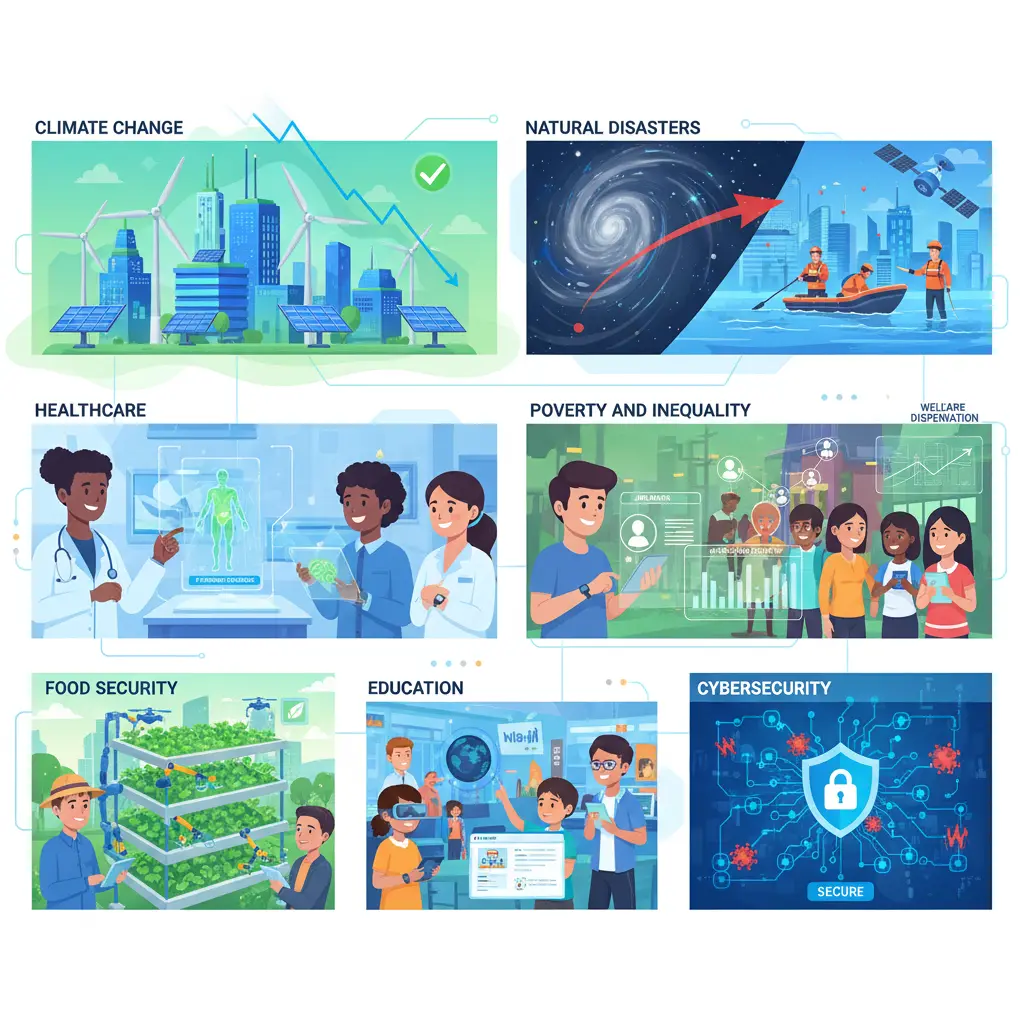
AI can be used to address all the significant issues in the world, such as in health, climate, and education.
Here’s how:
Climate Change and Environmental Degradation
One of the largest issues of the times is climate change.
Artificial intelligence is making us cognizant of it.
AI can:
- Track carbon emissions
- Predict climate patterns
- Optimize energy use
- Enhance the monitoring of air quality.
- Enhance green energy plants.
Google applied AI to cut the data center energy consumption by one-fourth.
This demonstrates the direct reduction of carbon footprints at the global level through AI.
Governments and scientists are also able to plan towards a cleaner and safer future using AI.
Natural Disasters and Proactive Response
Disasters hit fast.
Each year, floods, storms, earthquakes, and wildfires hit millions of people.
AI can save lives by:
- Anticipating disaster before.
- Mapping high-risk areas
- Sending warnings faster
- Assistance in rescuing victims.
- Guiding relief efforts
According to the UN reports, AI-based warnings can enhance the promptness of early warnings by up to 20 minutes, can save lives.
In the case of AI, it passes from reaction to prevention.
Healthcare Access and Disease Management
Artificial intelligence is transforming healthcare.
AI is used by doctors to identify diseases such as:
- Lung cancer
- Breast cancer
- Melanoma
- Diabetic retinopathy
- Tuberculosis
Research indicates that AI may be as accurate or even more accurate than experts in medical imaging.
Also, wearables that use AI can identify:
- Heart problems
- High blood pressure
- Blood sugar issues
- Sleep disorders
The WHO states that over 70 complications can be decreased with the help of this early observation.
AI is causing healthcare to become cheaper, faster, and more accessible to all.
Poverty and Inequality
Poverty is an international problem that has roots.
AI is beneficial since it provides a better understanding to governments and organizations.
AI can:
- Find bad communities quicker.
- Predict job market trends
- Enhance welfare dispensation.
- Stop fraud in aid systems
- Assist workers in getting superior jobs.
Job-matching technology that can be driven by AI can assist those individuals in low-income neighborhoods in finding jobs faster.
This results in equal opportunities and better economies.
Food Security and Agriculture
It is becoming challenging to feed the global population.
Artificial intelligence is assisting farmers to grow larger quantities of food using fewer resources.
AI can:
- Predict crop yield
- Early pests and plant disease detection.
- Optimize irrigation
- Reduce fertilizer waste
- Guide precision farming
According to the UN Food and Agriculture Organization, AI has the ability to boost efficiency in farms by 20 percent to 30 percent.
It translates to an increased food production, reduced wastage, and improved management of land.
Education and Skill Development
Education shapes our future.
Nevertheless, a good number of children do not have access to a good education. AI is closing this gap.
AI tools can:
- Deliver individualized instruction.
- Offer virtual tutors
- Track student progress
- Translating into local languages is important.
- Allow the students to learn differently.
This particularly enjoys strength in an isolated or underserved community.
AI makes world-class education a matter of any device.
Cybersecurity and Privacy
The world is becoming more digital, which is why cyber threats are growing. AI is used to guard individuals and systems against attacks.
AI can:
- Detect unusual behavior
- Block Internet attacks in real-time.
- Prevent fraud
- Protect personal data
- Monitor networks 24/7
IBM discovered that an AI can help lessen breach detection times by up to 280 days to less than 30 days.
This renders digital systems more secure for governments, companies, and other individuals who use them.
Pillars of AI-Driven Transformation
AI is powerful. But it doesn’t work alone.
It has four powerful pillars in its influence.
These pillars make AI develop, get educated, and address the problems of the world more quickly and efficiently.
We will divide them into simple and clear language.
Computing Power
AI needs speed.
It requires high-performance computers to enable it to process huge amounts of data.
The use of innovations such as modern chipsets, cloud platforms, and GPUs has enabled AI to do calculations that required weeks extempore, and this is within seconds.
The study indicates that the computing power of AI has increased approximately twice every 3-4 months in the past 10 years.
This is even more rapid than the Law of Moore.
More computing power means:
- Better predictions
- Faster learning
- Smarter AI models
- Real-time decision-making
And this is precisely how AI can contribute to the resolution of the global issues on a large scale.
Big Data
AI engages in learning just as a child learns from experience.
The current world is generating more than 328 million terabytes of data on a single day.
This includes:
- Climate data
- Health records
- Crop data
- Financial trends
- Satellite images
AI transforms such an enormous volume of information into knowledge.
It discovers the patterns that are not visible to humans.
It assists professionals in grasping what is and what is likely to follow.
Big data transforms AI into something smarter, more precise, and helpful in addressing world problems.
Human–AI Collaboration
AI is not a replacement for people but a companion.
Humans provide:
- Creativity
- Emotion
- Ethics
- Judgement
- Vision
AI provides:
- Speed
- Precision
- Pattern detection
- Automation
- Scale
When they combine, they come up with strong solutions.
Physicians apply AI in disease detection.
Artificial intelligence is used by farmers to identify pests.
AI is employed by teachers to customize lessons.
Scientists depict AI in order to forecast climatic changes.
It is this human thinking coupled with AI intelligence that is the key to addressing world issues.
Responsible and Ethical AI
AI is powerful. But power must be used wisely. To benefit the world, it has to be:
- Fair
- Transparent
- Safe
- Secure
- Accountable
This means:
- Avoiding biased data
- Protecting privacy
- Sharing how AI systems work
- Assuring that AI is not harmful to people.
- Building trust with users
Organizations such as UNESCO and OECD have models that determine the ethical development of AI.
The responsible AI will warrant the technology to add value without posing any threats to lives.
Suggested Read: https://heyeve.ai/blogs/ai-in-software-development/
How AI Augments Human Ingenuity to Solve Global Problems?
AI doesn’t replace people.
It enhances the capabilities of people.
Man introduces labor, emotion, intuition, and experience.
AI is fast, large, memory-facilitating, and accurate.
They achieve big things when they succeed in their collaboration.
- AI helps scientists to find new medicines within months rather than years.
- AI-powered devices allow farmers to guard crops before they are infested with pests.
- AI can be applied by teachers to provide each child with a unique learning plan.
- AI is used to diagnose diseases earlier than in history.
AI also empowers the human race to gain greater strength in solving problems:
- Huge datasets
- Fast predictions
- Pattern recognition
- Repetitive tasks
- Real-time analysis
That leaves people with more time to do things that can only be done by humans: think, make, connect, and lead.
This is the way that AI can assist human society to shift the paradigm of trying to solve the global issues to actually solve them.
Can AI Provide Solutions to Global Challenges?
Short answer: yes.
AI can offer real and quantifiable solutions to challenges the world is facing since it can:
- Anticipate risks that can harm.
- Do better in healthcare, climate, and education.
- Minimize the wastage and maximize the efficiency.
- Grow resource penetration in rural areas or low-income areas.
- Enhance digital and security safety.
- Solvability is faster than a system of humans alone.
AI is already being used to:
- Cut down energy consumption by 40% within large data centers.
- Diagnose ailments as accurately as medical doctors.
- Agriculture will increase by 20-30%.
- Enhance the times of disaster prediction.
- Empower millions of students with custom tools for learning.
The UN and McKinsey confirm the same:
AI will be critical in meeting global targets such as poverty eradication, climate change, and health enhancement.
Therefore, to the extent that human leadership and ethical applications are involved, AI can potentially resolve the global issues.
The Future of AI: Beyond Efficiency
The second stage of AI is not about activity, such as doing it better.
It is concerned with the answer to problems that used to be impossible.
Clean energy will be provided by AI. It will aid in the restoration of the climate.
It will assist researchers in coming up with new medicines. It will provide equal access by students everywhere to quality learning. It will be smarter, more safe, and personalized food systems, safer cities, and more personalized healthcare.
We are not just switching to utilizing AI as an instrument, but as a collaborator.
A partner to propel humanity to think bigger, act faster, and devise solutions that cut across the globe.
This is where AI is heading: the intelligence, innovation, and impact.
Conclusion
The answer to the question of how AI can solve global challenges is simple:
AI enables us to address some of the most challenging issues on our planet faster, more accurately, and globally.
It assists us in predicting catastrophes before they occur. It enhances healthcare among millions of people. It strengthens food systems. It reduces poverty. It protects digital spaces.
And it promotes sustainability to the world, united by the United Nations.
AI does not take over the human brain. It extends it.
There is a new future in which technology can enable every individual to live safer, healthier, and more empowered lives, and make responsible use of this resource with good human-AI cooperation.
Frequently Asked Questions (FAQs)
How can AI help solve global challenges?
AI is a solution to global problems, including predicting risks and making better decisions, waste reduction, assisting doctors and educators, and offering scalable data-driven solutions.
What global issues can AI address?
Climate change, poverty, inequality, healthcare gaps, food insecurity, education issues, and cybersecurity threats are the problems that can be solved by AI.
Can AI help reduce poverty?
Yes. Applications of AI make welfare systems more productive, trend predictive, job matching, financial inclusion-friendly, and help governments know which communities need assistance the most.
How does AI improve healthcare access?
AI is used to diagnose disease at an earlier stage, analyzing health images, remote care, and wearable health devices, and providing doctors with more insight and accurate data faster.
Is AI essential for achieving UN SDGs?
Yes. The UN confirms that AI and digital technology are important in achieving the 2030 Sustainable Development Goals, particularly the health, climate, education, and economic growth.